3.8t
CO₂ avoided per Manila EV / year
Based on a petrol-equivalent comparison using the Philippine Meralco grid emission factor.

WattUp APAC’s impact model connects commercial fleet deployment with environmental reporting, driver outcomes, and city-level evidence that can stand up to utility, media, and ESG scrutiny.
WattUp APAC treats impact reporting as part of the operating model itself — linking vehicle activity, charging behaviour, and quarterly stakeholder reporting instead of relying on broad sustainability claims.
Based on a petrol-equivalent comparison using the Philippine Meralco grid emission factor.
The 2028 target translates to 19,000+ tonnes of annual CO₂ avoided in the Philippines alone.
Transport contributes meaningfully to urban particulate pollution in cities like Metro Manila and Bangkok.
WattUp APAC commits to publishing impact reporting for stakeholders and partners every quarter.
“The point is not to publish impressive sustainability language. The point is to prove that real fleets can run cleaner, more consistently, and at meaningful urban scale.”
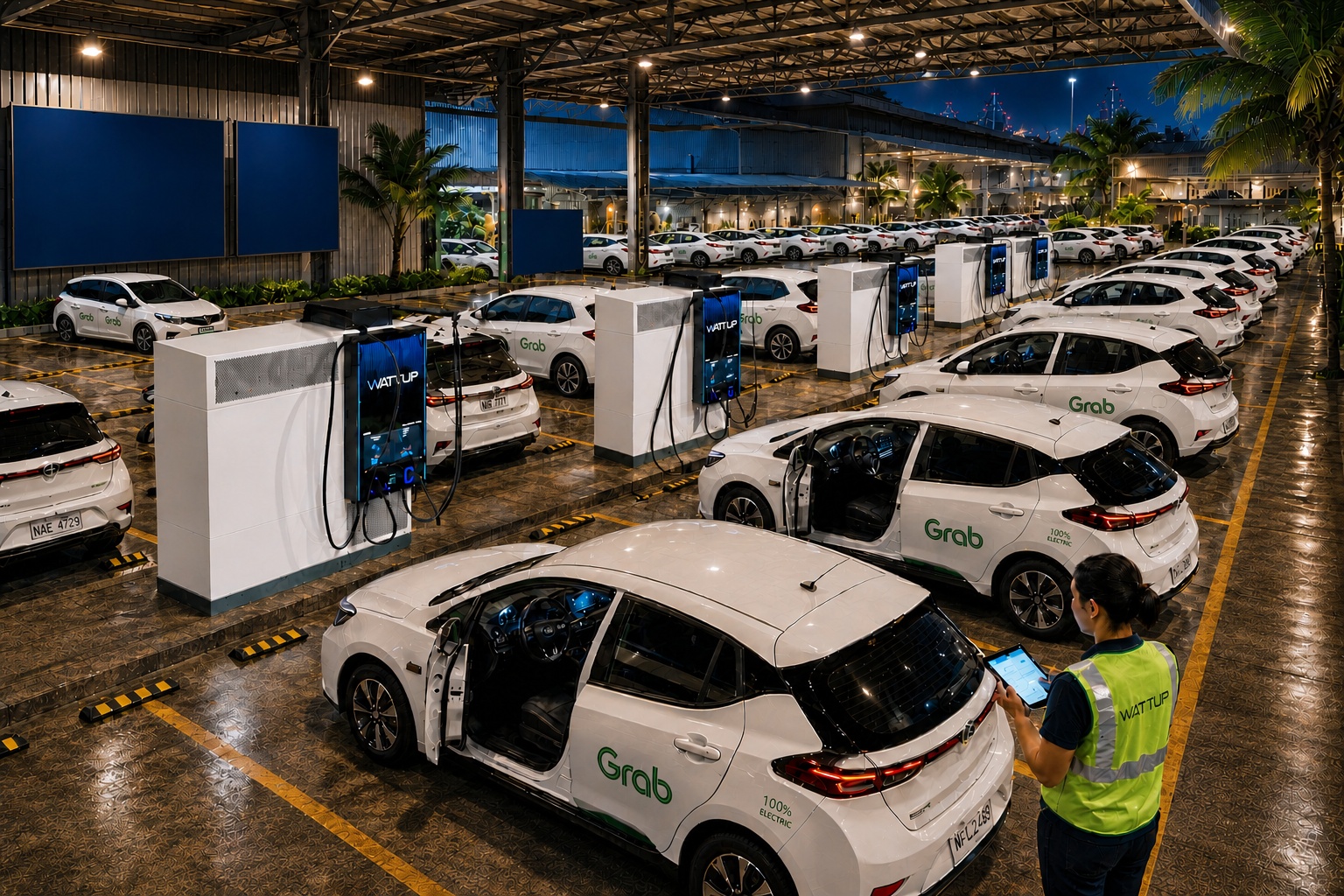
The model matters because driver economics, workforce dignity, and operator stability are inseparable from the environmental case for fleet transition.
A managed EV fleet model can reduce fuel volatility, improve daily predictability, and support healthier take-home economics for professional drivers working long urban shifts.
Modern vehicles, quieter cabins, lower maintenance interruption, and app-integrated operating systems improve the day-to-day reality of professional driving.
Cleaner, professionally managed fleets can support safer onboarding and more inclusive recruitment pathways for drivers who have historically faced barriers to entry.
WattUp APAC’s reporting model is designed to support market conversations with city authorities, utilities, and institutional partners across four priority expansion markets.
| Market | Primary policy relevance | How WattUp APAC aligns | Reporting value |
|---|---|---|---|
| Philippines | Urban air quality, ride-hailing decarbonisation, and early charging-network coordination | Supports cleaner metro mobility and measurable fleet transition pathways with utility-visible load growth. | Quarterly reporting on vehicle deployment, CO₂ reduction, and partner-fleet readiness. |
| Thailand | EV manufacturing strength, city transport electrification, and fleet modernisation | Creates a commercial pathway between OEM momentum and real city-level fleet utilisation. | Evidence base for operator uptake, charging behaviour, and city-facing sustainability reporting. |
| Indonesia | High two- and four-wheel urban transport demand with rising interest in managed charging | Supports structured electrification where dispatch intensity and depot coordination matter most. | Operational and utility-ready outputs that help prove repeatability before larger-scale rollout. |
| Malaysia | Corporate fleet transition, utility coordination, and lower-emission urban mobility planning | Demonstrates a commercially grounded fleet model rather than a pilot disconnected from economics. | Partner-ready reporting on fleet performance, charging discipline, and measured impact outcomes. |
The framework is intentionally simple: cleaner energy use, better work, healthier cities, and credible climate accountability.
Smart depot charging supports more efficient electricity use and clearer utility coordination as EV fleet demand grows.
A stable fleet model can improve working conditions and earnings visibility for professional drivers and local operating teams.
Replacing petrol fleet miles with managed EV operations reduces harmful urban emissions where congestion and exposure are most acute.
Quarterly impact reporting ties decarbonisation claims to live vehicle deployment and measurable operating activity.
Carbon-credit participation is approached as an operational extension of the platform — grounded in measurable fleet activity and managed programme administration.
Vehicle usage, charging behaviour, and emissions displacement are documented through the operating platform to support credible baseline analysis.
WattUp APAC manages the programme work needed for relevant voluntary carbon and crediting pathways where the market structure supports it.
Carbon-credit upside is treated as part of the long-term fleet model, not as a speculative side narrative disconnected from operations.
WattUp APAC publishes impact reporting to connect vehicles in operation, CO₂ outcomes, driver economics, and fleet readiness into a single stakeholder story.