“Every fleet we electrify reduces urban CO₂, improves air quality, and creates a stable, utility-visible charging profile at the depot level.”
WattUp APAC public-partnership position

WattUp APAC works with cities and utility partners that want commercial EV adoption to cut urban emissions while creating predictable, manageable charging demand across real fleet operations.
The right fleet programme can improve air quality, reduce transport emissions, and create more predictable load for local power systems — but only if the operator model is commercially viable on the ground.
“Every fleet we electrify reduces urban CO₂, improves air quality, and creates a stable, utility-visible charging profile at the depot level.”
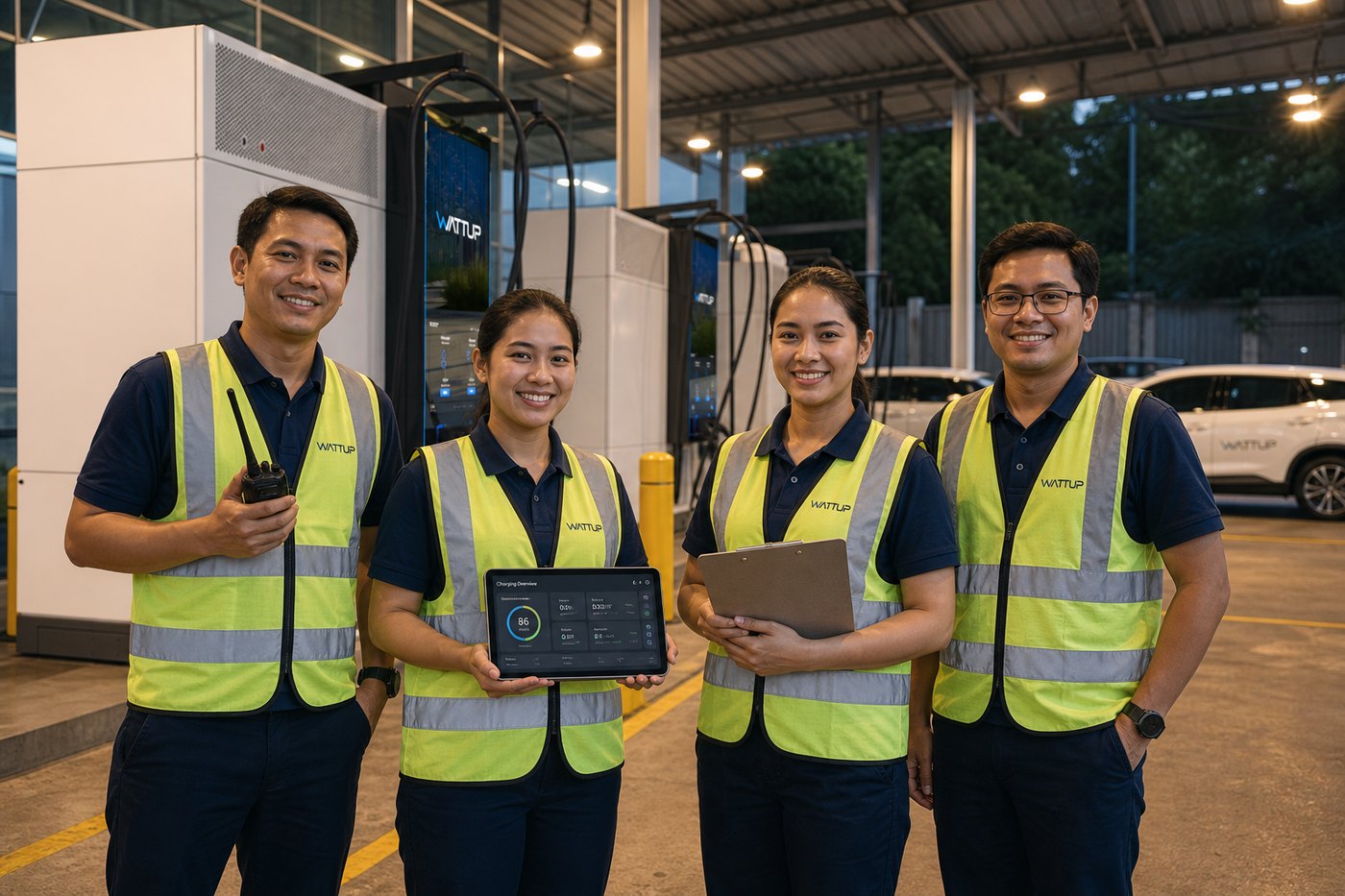
Fleet electrification removes high-frequency petrol vehicle emissions from corridors where residents experience congestion every day.
Depot charging concentrates demand into planned operating windows, creating a better coordination surface for utility partners.
WattUp APAC tracks fleet deployment, utilisation, readiness, and impact so public and power-sector stakeholders can see real outcomes.
Cities and utilities do not need to become fleet operators themselves. They need operating partners whose incentives align with successful deployment.
These are the utility pathways currently anchored in the operating plan and regional market sequence.
| Market | Utility | Role in the model | Status note |
|---|---|---|---|
| Metro Manila, Philippines | Meralco | Grid coordination for live and scaling fleet depots serving ride-hailing and urban transport demand. | Current proof-point market with active operating relevance. |
| Bangkok, Thailand | EGAT | Structuring pathway for depot charging, power planning, and readiness in a dense ride-hailing market. | Priority expansion market referenced in the brief and market map. |
| Jakarta, Indonesia | PLN | Future utility coordination model for large-scale urban fleet electrification and tariff-aware charging design. | Expansion market with high-density operating potential. |
| Kuala Lumpur, Malaysia | TNB | Utility-aware launch planning for premium corporate fleet and ride-hailing deployment. | Regional template market for repeatable expansion. |
WattUp APAC does not frame policy as a marketing backdrop. The point is to convert it into active commercial fleet deployment and measurable public outcomes.
| Market | Policy framework | How WattUp APAC supports it |
|---|---|---|
| Philippines | EV Industry Development Act (RA 11697) | Commercial EV deployment, depot charging, and live fleet reporting turn policy intent into measurable operating outcomes. |
| Thailand | EV 30@30 | Fleet-scale deployment accelerates commercial adoption ahead of broader market maturity. |
| Indonesia | PR 55/2019 | Supports urban transport and ride-hailing electrification with structured operator partnerships. |
| Malaysia | NETR | Connects transport decarbonisation goals to an execution-ready fleet model. |
We identify which vehicle segments, operators, and depot realities offer the best path to commercially durable electrification.
City priorities, utility constraints, and operator economics are mapped together before infrastructure is deployed.
Depot charging, load shaping, readiness targets, and stakeholder reporting are defined as one operating system.
Vehicles enter service with operating telemetry, utilisation data, and impact tracking live from day one.
The platform combines operational visibility and impact reporting so stakeholders can evaluate whether the programme is delivering cleaner mobility, sounder economics, and manageable grid behaviour.
Load windows, charging behaviour, and depot-readiness patterns can be shared in a utility-relevant format.
Cities can see whether EV adoption is actually occurring in commercially meaningful transport segments.
CO₂ reduction, cleaner corridors, and driver-economics signals can be packaged into quarterly stakeholder reporting.
Quarterly reporting can include active vehicles, fleet utilisation, charging performance, corridor-level emissions reduction, and utility-visible charging characteristics, with a clear distinction between live and forecast data.
If you are shaping an EV programme, evaluating utility coordination, or looking for a commercially viable fleet pathway, start with the details here.